Every sign that goes up looks simple once it’s finished, clean faces, even lighting, straight lines. What that finished product hides is everything that had to be solved to get it there: missing drawings, inaccessible rooflines, decades-old fixtures with no digital record of their original shape.
For general contractors and project managers juggling a healthcare campus build or renovation, signage is rarely the hardest part of the job. These three installations at Froedtert Health in the Milwaukee area show what “getting it right” actually requires.
1. Froedtert Cancer Center: A Re-lamp That Became a Reface
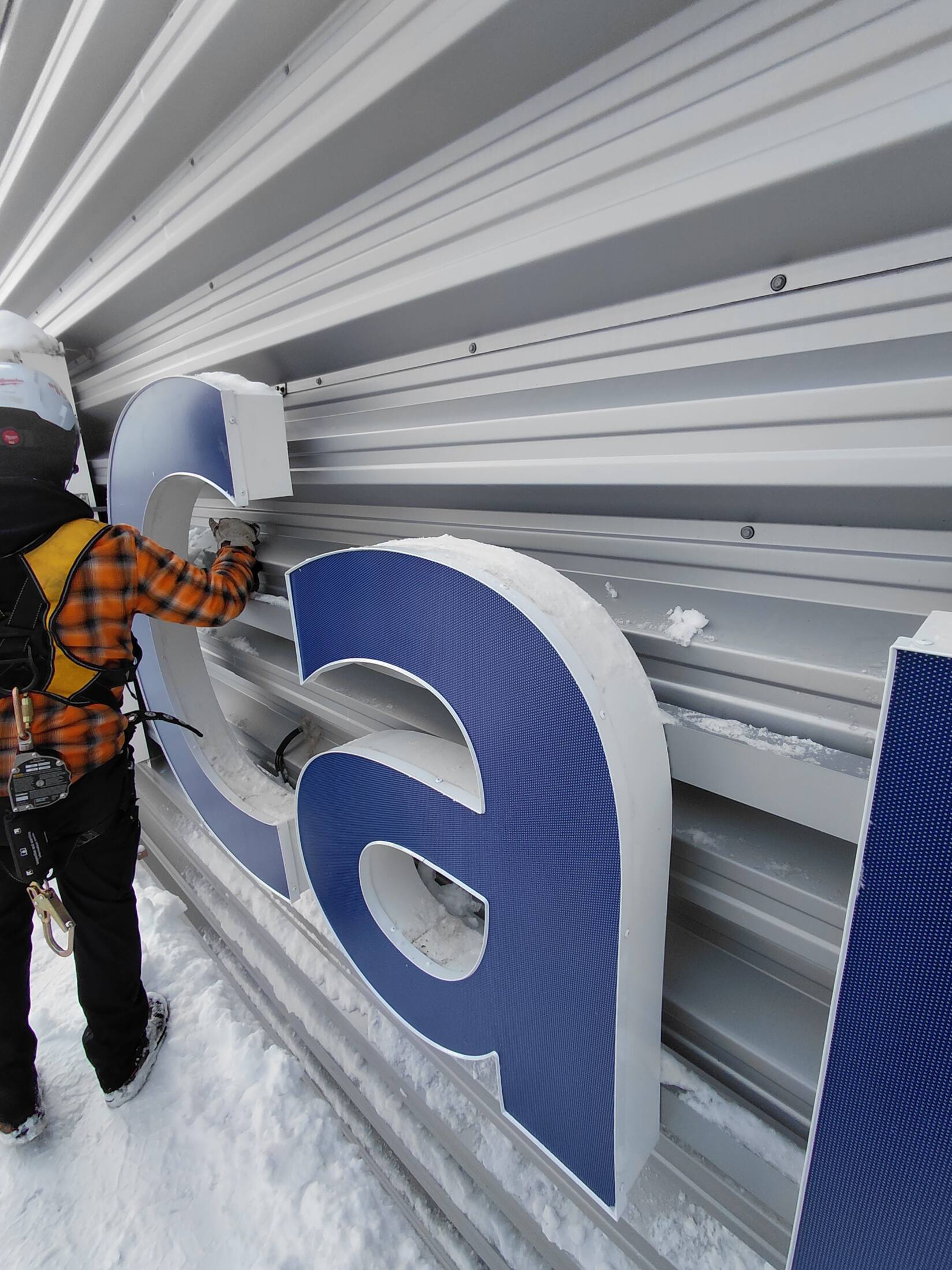
This project was quoted as a straightforward re-lamp job, swap out the internal lighting, keep the existing faces. But a closer look at the cabinets made clear that the faces themselves needed to be replaced too, turning a lighting job into a full reface.
The bigger challenge was access. The Cancer Center signage sits high enough that the crew had to build scaffolding on the roof just to reach the cabinets safely. And because the design called for the letters to appear crisp white after dark, the new faces were finished in blue perforated vinyl film, a material that reads blue in daylight but glows white at night once backlit.
It’s a detail most people driving by will never think about, but getting the film choice and the lighting to work together is what makes the sign look intentional at every hour.
Bottom line for GCs and PMs: when a “relamp” quote turns into a reface mid-project, having a fabricator who can adapt scope, materials, and access planning on the fly keeps the schedule from slipping.
2. Froedtert CFAC: Solving for a Sign With No Paper Trail
The CFAC re-lamp came with a complication before the crew ever touched the sign: there was no production drawing on file. Without that documentation, the team had to work from what was actually in the field rather than a set of specs.
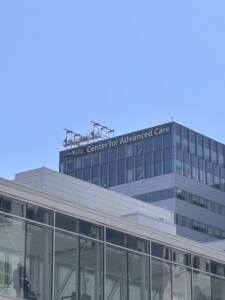 The real challenge, though, was reaching the cabinet faces at all. The existing swing stage, the suspended platform used to access the building’s exterior, wasn’t built to get installers to every face that needed work. Our crew modified the swing stage itself so it could reach each face safely, effectively engineering a custom access solution in the middle of the project.
Bottom line for GCs and PMs: on older buildings, “no drawing on file” doesn’t have to mean “no plan.” It means the fabricator needs to be comfortable field-verifying conditions and adapting access equipment, not just installing to spec.
3. Froedtert North Tower: Rebuilding Faces With No Digital Record
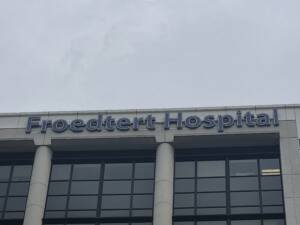
The North Tower re-lamp and reface presented a fabrication puzzle: there were no digital records to cut new faces from. The originals existed only as physical parts on the building, with no file to pull up and send to the CNC router.
Our CNC technician solved it by building a custom jig out of 1-inch grid paper. As the old faces were removed from the field, they were photographed against the grid, giving the shop accurate, scaled reference images. From there, new faces were cut to match the originals exactly. Like the other two Froedtert projects, the finished faces were done in blue perforated vinyl, appearing blue by day and white at night once lit.
Bottom line for GCs and PMs: when there’s nothing digital to work from, the fabrication shop’s ability to reverse-engineer accurate parts from the field is what keeps a re-lamp project from turning into a full remake.
What These Three Jobs Have in Common
 These sign installations were challenging because of what surrounded the sign: missing documentation, limited access, and site conditions that didn’t match the original scope. In each case, the fix came down to the same thing, a crew and shop willing to adapt in the field rather than stall the project waiting for perfect information.
Getting signage right on a healthcare campus is about having a partner who can problem-solve access, materials, and documentation gaps without derailing your timeline.
Working through a signage scope with incomplete drawings or tricky access? Let’s talk.